SCDO: Structural Chrominance Domain Optimizer
High-precision synthetic datasets for industrial machine vision—trained in days, deployed on legacy edge hardware.
SCDO is a proprietary synthetic data pipeline developed by Droidknot LLC. Originally created for a computer vision art installation (Prosthetic Memory), we discovered its architecture solves one of manufacturing’s most expensive bottlenecks: training fast, reliable object detection models on complex, reflective, or articulated parts without collecting thousands of real-world images.
1. Real-Time Production & Edge Inspection (SCDO + YOLOv4)
Our primary deployment model delivers high-confidence object detection on resource-constrained and legacy hardware (such as NVIDIA Jetsons and existing line cameras).
- 95%+ detection confidence across varied lighting conditions and reflective metal surfaces.
- Full multi-pose robustness: Accurately tracks articulated or rotated parts—such as folded multi-tools or inverted derailleurs—from under 300 synthetic training frames per class.
- Drop-in delivery: We deliver compiled .weights, .cfg, or .onnx files ready for your existing inference pipeline.
This is a live inference example.
2. Post-Hoc Validation & Hybrid Ensembles (SCDO + RF-DETR)
To test architectural boundaries, we benchmarked an SCDO-trained model (purple labels) against a standard RF-DETR transformer model trained on the MS-COCO dataset (yellow labels) using real-world street footage from San Francisco.
Test footage courtesy of the Street Tour SF Youtube channel.
While transformer architectures like RF-DETR excel at wide, deep-field context, they frequently drop out during extreme close-ups and heavy cropping. SCDO shows the exact opposite profile: shallower depth range, but rock-solid confidence and zero dropout on close-up, occluded, or cropped targets.
By pairing SCDO with RF-DETR in a post-processing ensemble, the two architectures cover each other’s blind spots—making them ideal for offline safety audits, quality verification, and automated ground-truth validation. We are actively developing distilled and fine-tuned hybrid models based on this architecture.
3. Orders-of-Magnitude Smaller Datasets—Even From Scale Proxies
The SCDO motorcycle model in the comparison above was trained on just 264 total images generated from four $20 die-cast toys—yet it holds its own against a standard COCO class trained on 3,661 segmented real-world images.
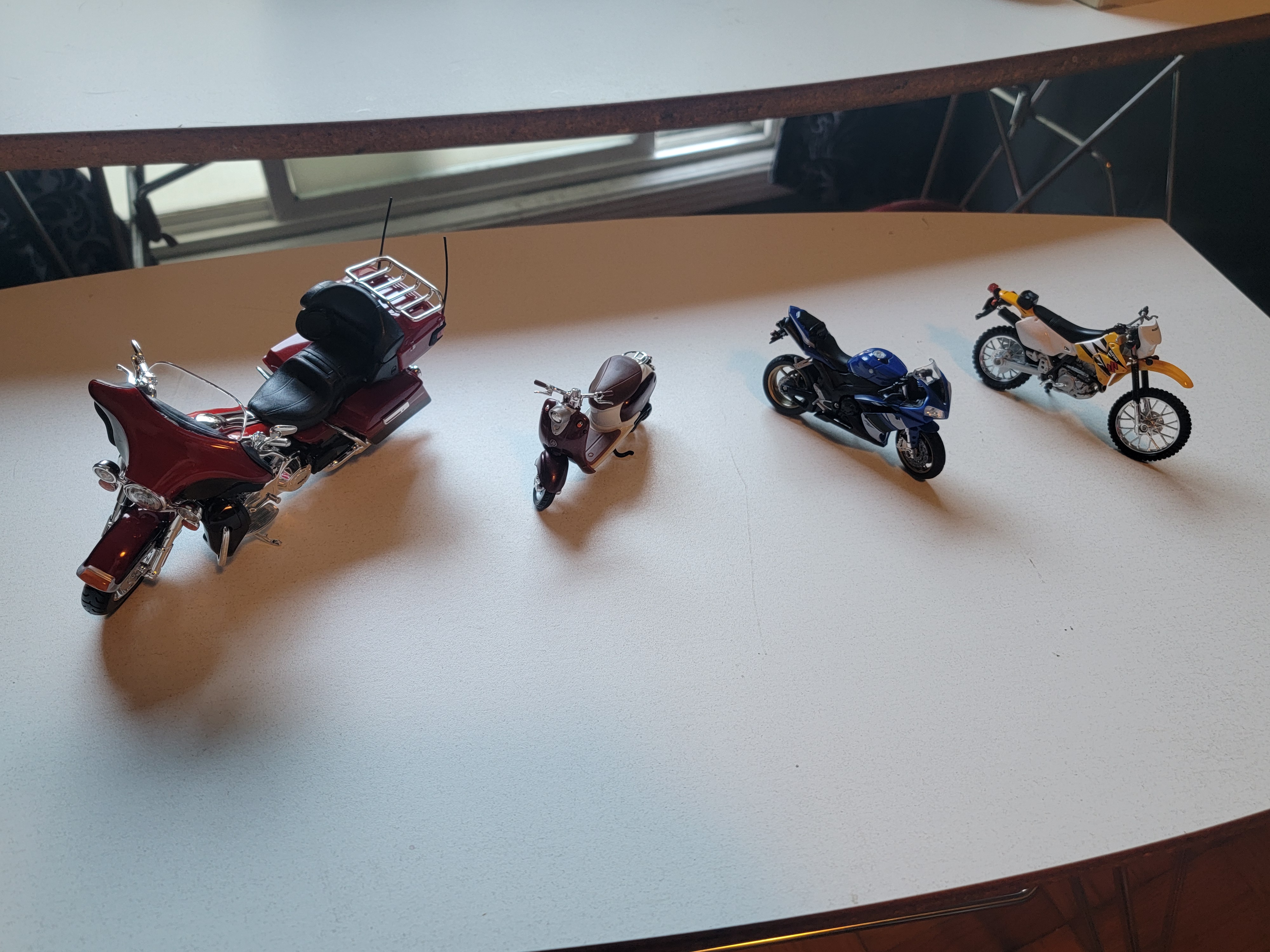
The entire source truth for the 264-image SCDO motorcycle dataset.
What this means for your operation:
- For Manufacturers: Skip months of manual data collection and labeling. Send us a sample part—or standard multi-angle footage—and receive a production-ready model in under a week at a fraction of traditional ML engineering costs.
- For System Integrators: Stop letting custom dataset creation stall your cell deployments. Outsource the data bottleneck to us, protect your project timelines, and expand your integration margins.
- For Heavy Infrastructure & Utilities: Because SCDO generalizes from scale models and physical proxies, you can train detectors for massive or hazardous assets—like power pylons, wind turbines, or mining equipment—before deploying a single drone in the field.
Run a Zero-Risk Bench Test
Have a stubborn SKU, reflective metal component, or multi-pose assembly that your current vision system struggles to track?
Contact us at droidknotgames@gmail.com to schedule a brief technical call or arrange a free sample bench test on your target part.